Saturday, September 12, 2015

History of Film Part 6 - Sergei Eisenstein and the Russian School ofFilm


Sergei Eisenstein

The two great Russian filmmakers are Andrei Tarkovsky and Sergei Eisenstein. Eisenstein is the more influential. Eisenstein came from the Russian school of film theory and was deeply influential in developing the Russian montage. 

The Russian montage didn't focus so much on narrative in the editing, but more rhythm and the psychological nature of the audience to move the film forward. Take this sequence from Sergei Eisenstein's masterpiece Battleship Potemkin. http://youtu.be/laJ_1P-Py2k . The Odessa Steps sequence is one of the most copied, for good reason.
 The impact is in the cuts. As Martin Scorsese put it about this classic scene that would take from the Russian Montage school of editing, the violence is in the cuts http://youtu.be/8VP5jEAP3K4.


Because of the Russian Montage and the influence of Eisenstein we get this http://youtu.be/cQCQRLA05AA, this http://youtu.be/sDZvP9aWXwM, this http://youtu.be/Gv2sSLU8PJk, and this http://youtu.be/J0BrdMi-oyc

Ultimately the Russian Montage couldn't sustain the narrative of an entire film, as Eisenstein had hoped, but it did lead to a thematic punch and would lead to some of the most classic scenes in movie history.  

Lastly, note these scenes from Eisenstein's later films. The first, The Battle Of The Ice, from Eistenstein's Alexander Nevsky was heavily influential on Stanley Kubrick and Spartacus in particular. http://youtu.be/vKZPgGbUuX0. Note how Eisenstein edits to the rhythm of the music to build tension. 

And, lastly this scene from his final epic, Ivan the Terrible, Part 1. http://youtu.be/fub8u33UF2s
You can find Eisenstein's Ivan The Terrible parts 1 & 2 here http://hulu.com/s/6SV on Hulu, as well as October: Ten Days That Shook The World http://hulu.com/w/HBFU
http://hulu.com/w/HBFU. You can find Eisenstein's Battleship Potemkin and Strike on Netflix. 

Monday, August 31, 2015

History of Film Part 5-Shadow Play- How Germany Changed Cinema


The German Expressionist movement in film started in 1920 with The Cabinet of Dr. Caligari and ended with Metropolis in 1927; its influence is still being felt. The Weimar Republic that was killing the German mark and paving the way for the nazis in World War II also produced the atmosphere for some of the greatest filmmakers ever to thrive and create some of the greatest films ever made. Many of them would be seduced by Hollywood and see a chance to escape an increasingly hostile political environment. Expressionism was already a movement in painting and on the stage. The Weimar Republic was causing incredible inflation and had shutdown the importing of foreign firms but was encouraging the export of German films. The mix of these three things produced an environment for genius to thrive. Were going to look at three of those filmmakers: Ernst Lubitsch, Fritz Lang and F.W. Murnau.


What would Lubitsch have done?

Ernst Lubitsch was born January 29, 1892 in Berlin. At the age of 16 he discovered a love for acting and the stage. He dropped out of school and started out as a bit player in stage productions. To make ends meet he took a handyman job at Bioscope film studios. He would soon be acting in films there. He found success playing the Jewish comic relief. He would soon give up acting, instead focusing on directing. Lubitsch's film would be hugely successful and ,as we'll see the trend goes, he would be beckoned by that Siren's call and head for Hollywood. The enchantress that beckoned him west was Mary Pickford, who contracted him to direct Rosita in 1922. The director and star clashed, but the film was a huge critical and commercial success. In Hollywood, Lubitsch would stay making such classics as The Marriage Circle, Trouble in Paradise, and To Be Or Not To Be. He would also serve as the head of Paramount studios. "What would Lubitsch have done?" hung on the wall of the director Billy Wilders' office. At Lubitsch's funeral Billy Wilder would say "No more Lubitsch." Fellow director, William Wyler,  responded, "Worse than that. No more Lubitsch pictures." 


Master of Darkness

The most prolific and powerful of these three German directors was not born in Germany, but in Vienna, Austria-Hungry December 5, 1890 (although Hitler disagreed, Austria = Germany). Friedrich Christian Anton Lang, known as Fritz Lang, was the second son of an architect father and Jewish mother, although they where devoutly Roman Catholic. Between 1910 and the out break of World War I he traveled through Europe, Africa and Asia. When the Great War started he volunteered for the Austrian army fighting on the eastern front in Romania  and Russia, being injured three times. After being discharged from the army in 1918, he started acting for a brief period of time with the Viennese theater circuit before being hired as a writer for a German production company. He soon started directing. His films started becoming increasingly more popular. In 1918 he met writer Thea von Harbou. They not only became writing partners, but also began an affair. Von Harbou would divorce her husband in 1920 and they would marry upon the death of Lang's wife in 1922. She would cowrite all Lang's films from 1921 - 1933. During the 1920's Lang would make such classics as the over four hour Dr. Mabuse the Gambler in 1922, and the over five hour long Die Nibelungen in 1924. He would then travel to Hollywood, stopping by New York City along the way. The skyscrapers of New York City would inspire his next film and the film that would bookend German Expressionism, that film was Metropolis. Metropolis was the most expensive German film up to that point. It ultimately would not be a huge success and would sink the studio. Given the test of time it ultimately would be received as not only one of the greatest science fiction films of all times but one of the greatest films of all times. He would follow Metropolis up with another science fiction film Lady in the Moon and then Lang would make the first German sound film M in 1931. Lang considered this dramatic thrill about a child serial killer and mob rule his greatest work. His next film The Testament of Dr. Mabuse would be his last film in Germany. Upon completion of The Testament of Dr. Mabuse he was called into the office of the propaganda minister of the new nazi government, Joseph Goebbels, who informed him that his film was to be banned, but Hitler was a huge fan of his films, particularly Metropolis, and they wanted him to be head of the German studio UFA. Lang stated that during that meeting he decided to leave Germany. While Lang might make it sound like he cleaned out his accounts the next day and hopped the next train to Paris, it was more likely that he left a few weeks or months later. He made one film in France before leaving to America where he make his first American film, Fury, with Spencer Tracy in 1936. Lang would eventually return to German cinema making his final film, the Thousand Eyes of Dr. Mabuse, in 1960. He would also act as himself in Jean-Luc Godard's masterpiece, Contempt. Lang past away August 2, 1976 in Beverly Hills, Ca. 


"Murnau, raised in the dark shadows of expressionism, pushed his images as far as he could, forced them upon us, haunted us with them." - Roger Ebert

The last director that we will be looking at is arguably the greatest and had the shortest career. He pushed the movement of the camera to new places, played with shadows and light, used special effects to forward his stories, and gave us some of the most memorable images ever put on film. His name, Friedrich Wilhelm Plumpe. He was born December 28, 1888 in Bielefeld, Province of Westphalia, German Empire. He would take the name Murnau after the town Murnau am Staffelsee which he said had an icy, imperious disposition and an obsession with film. He would be known as F.W. Murnau. He was already well read and making plays at home by the age of 12. During World War I he fought in the German Air Force, surviving several crashes. 
After World War I he started directing films, making The Boy in Blue in 1919 and Der Janus-Kopf in 1920, staring Béla Lugosi who ten years later would play Dracula. Ironically, F.W. Murnau could not get the rights to Bram Stoker's novel so instead altered the story slightly and made his expressionist masterpiece and most well known film, Nosferatu. He would be sued by Stoker's widow and lose the lawsuit. The court ordered that all prints be destroyed. Luckily, that didn't occur. Murnau would stretch the movement of the camera in his 1924 film The Last Laugh before making his last German film, a visual tour-de force, Faust. After that he, like Lubitsch and Lang, would make his way to Hollywood, being offered complete  control. He would make one of the cinema's greatest masterworks, Sunrise: A Song of Two Humans. Many of the exterior scenes were filmed in Lake Arrowhead, Ca. The film won the first ever Academy Award for Unique and Artistic Production (the only time the award was given, it was like a second best picture category). In the latest Sights and Sounds top films poll (2012), Sunrise was voted the 5th greatest film of all time. He would make three more films in America, dying in a car accident in Santa Barbara California a week before his last film, Tabu, was released. 

History of Film Part 4- Silent But Hilarious

 At no time in film history has the comedy been more revered. The comedy cinematic  masterpieces have never been so rich. You may not know the films, but you know the images. I'm going to focus on three comic stars of the silent era: Harold Lloyd, Buster Keaton, and Charles Chaplin.


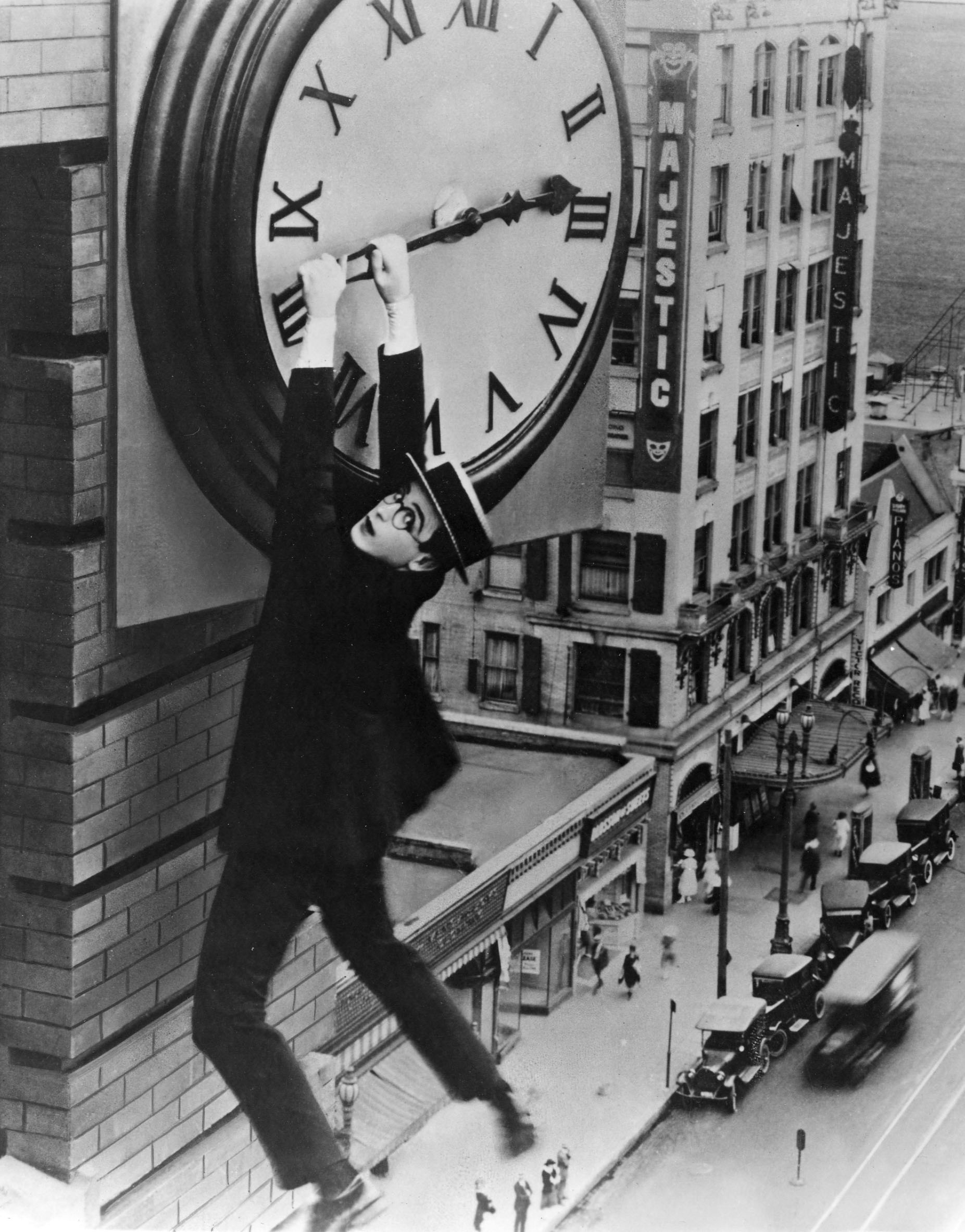
Harold Lloyd was more the straight man dropped into an out of place situation than Buster Keaton or Charlie Chaplin's Tramp. Harold Lloyd was also the most prolific of the bunch and did the greatest feats of daring of the group (see Safety Last!). Films of note are The Freshman and the aforementioned Safety Last!. 


"[Keaton's] extraordinary period from 1920 to 1929, [when] he worked without interruption on a series of films that make him, arguably, the greatest actor-director in the history of the movies."
Roger Ebert

Joseph Frank Keaton was born October 4, 1895 to vaudeville performers. He would be known for his incredible stunts and deadpan face. When he was two he fell down a flight of stairs in a hotel. He got up and brushed it off as though nothing had happened. Among the witnesses to this was Harry Houdini who exclaimed "That's a real buster!"; from then on he'd be known as Buster Keaton. From the age of four Buster Keaton would preform with his family's act. Keaton started his career in film with another of silent film's comedy greats and tragic figures, Fatty Arbuckle. Buster Keaton made not only arguably the best comedy of the silent era, but arguably the greatest comedy of all time, The General. As Orson Welles put it "the greatest comedy ever made, the greatest Civil War film ever made, and perhaps the greatest film ever made.". 

Ultimately, the film that today is seen as one of the great films (number 34 on Sights & Sounds 2012 poll, in the top ten in 1972 & 1982, and number 18 on AFI 100 greatest films among others), The General would be a critical and financial failure. He would be stripped of his independence and crushed in menial demeaning rolls by the studio. He would see a resurgence in his career at the end of his life as his films were rediscovered. Other films of note would be Sherlock Jr., Steamboat Jr. (from which perhaps his most famous stunt was preformed https://youtu.be/FN2SKWSOdGM), and The Cameraman.


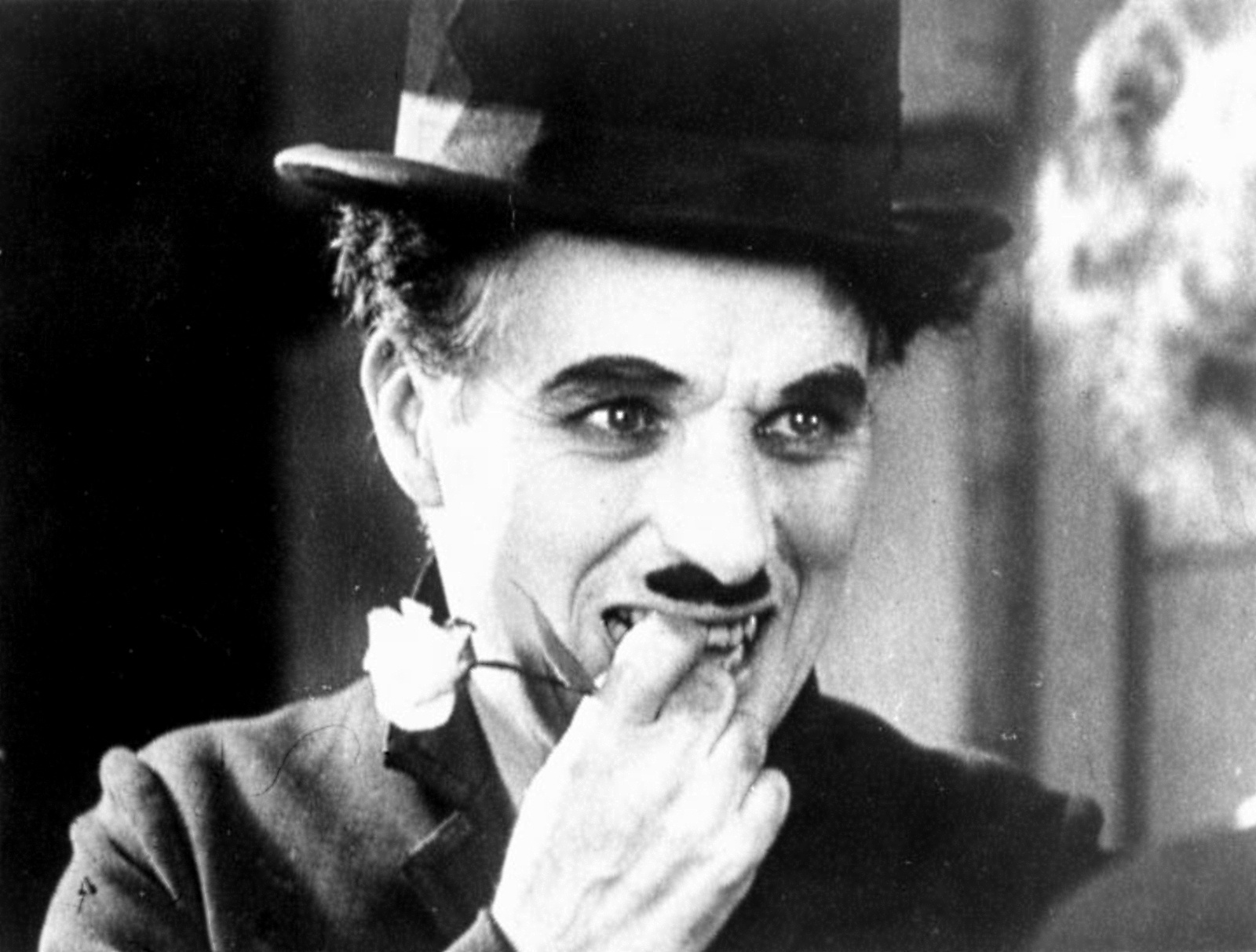
Sir Charles Spencer "Charlie" Chaplin was born to performer parents April 16, 1889. His father abandoned them after his mother became pregnant with his brother through an affair; his mother had to be committed most of her life due to mental problems, leaving him and his brother to more or less make their own way. They made a living as music hall performers which is how he made his way to America in 1908 with the Fred Karno company. In 1914 he was discovered by Mack Sennett and signed to his Keystone Studios, makers of the famous Keystone cop films.  Chaplin quickly became disenchanted with Mack Sennett way of making films and wanted to do more fleshed out routines. Sennett hated Chaplin's way of doing things, but Chaplin's films where hugely popular. Ultimately Chaplin would break away from Keystone Studio and move to another, and another; before starting his own studio with D.W. Griffith, and his good friends Douglas Fairbanks and Mary Pickford. The studio, United Artist. 

He wouldn't make his classic film, The Kid, for his new studio; or the next couple, but he would make the film he most wished to he known by, The Gold Rush. It would be a huge success. His next film, Chaplin would be given its own special Academy Award for "for writing, acting, directing and producing The Circus.". Chaplin would go on to make classics like City Lights, Modern Times, The Dictator and Limelight (with Buster Keaton in a cameo, the only time the two would share the big screen).  

Saturday, August 22, 2015

History of Film Part 3- D.W.


"I have never really hated Hollywood except for its treatment of D. W. Griffith. No town, no industry, no profession, no art form owes so much to a single man."
Orson Wells

David Llewelyn Wark Griffith was born on January 22, 1875 in LaGrange, Kentucky. His father was a Confederate Colonel who died when he was ten. He grew up poor. He had aspirations of being a playwright. He would fall into acting in hopes of those ends. He would give birth to film as we know it. He would best be know as D.W. Griffith.  

D.W. Griffith wanted to make it as a playwright and found the best way was as an actor. He would work his way into film starting as an actor for Edwin S. Porter in "Rescued From an Eagle's Nest" http://youtu.be/Ghxyw4zAEAk in 1908. Later that year Griffith would direct his first film "The Adventures of Dollie" http://youtu.be/rvIH0MzPQ14

Griffith would make great innovations is cross cutting, lighting, continuity, editing and acting. Charlie Chaplin would call him "the teacher of us all". Lillian Gish (who Griffith discovered) would call him "the father of film". Here are some examples of D.W. Griffith's early work. The Musketeers of Pig Alley http://youtu.be/ZxCBvgnjmPU, The Burglar's Dilemma http://youtu.be/tS2zqI9V6F8, The Sunbeam https://youtu.be/FZZv34GueWQ, and the first film of Dorothy and Lillian Gish "An Unseen Enemy" https://youtu.be/BVSFlSxNvLg. Griffith would make hundreds of films before 1915. In 1915 he would take all his invocations and all his experience up to that point and he would change film forever. What he would do is give birth to film as we know it. He would make the cinemas first real masterpiece and give rise to the feature film. The film he made? Birth of a Nation http://youtu.be/I3kmVgQHIEY.


With Birth of a Nation Griffith wanted to make a real evening's experience, like going to The Theater. Rather than making 15 to 30 min shorts he wanted to make a 3 hour experience, epic in story and production. The studio was happy to leave well enough alone so opposed his plan,  like his other innovations, intercutting storylines for instance. D.W. Griffith was not willing to follow his studio overlords and left the studio and did it himself. The film is equally know for its racist content as its impact to film. The Birth of a Nation showed the impact film could have and led to race riots and helped with the KKK rising again. It would also be the first film screened at the White House, admittedly by the president that segregated the federal government Woodrow Wilson. 

I should say something about something you wouldn't expect from a film pre1927, and that is sound. Birth of a Nation was meant to have an accompanying symphony. When you hear "Charge of the Light Begrimed" while watching Birth of a Nation, that is what Griffith intended in 1915.


Shocked by the riots and negative reaction to Birth of a Nation, D.W. Griffith would double down with one of the most epic films ever to be made, Intolerance https://youtu.be/eo66cJqEl4A. The story would go from The hanging Gardens of Babylon to a poor widowed woman in modern times and everywhere in between. The film sets and amount of extras used would be massive. And DW Griffith would control this with no script, the entire story and stage direction was in his head. Ultimately the film would be a financial failure, mostly due to its massive roadshow production, and the film would put DW Griffith into debt for the rest of his life. The film would go on to be hugely influential throughout the history of film particularly in Russia, but more on that later. 
Griffith would go on to found United Artist with Charlie Chaplin, Douglas Fairbanks and Mary Pickford. His stay there would not be long. While he would go on to make other classics, most notably Broken Blossoms, ultimately the system he helped create would reject him. He died July 23, 1948.  

Tuesday, August 18, 2015

History of Film Part 2- From a Prince to a Porter

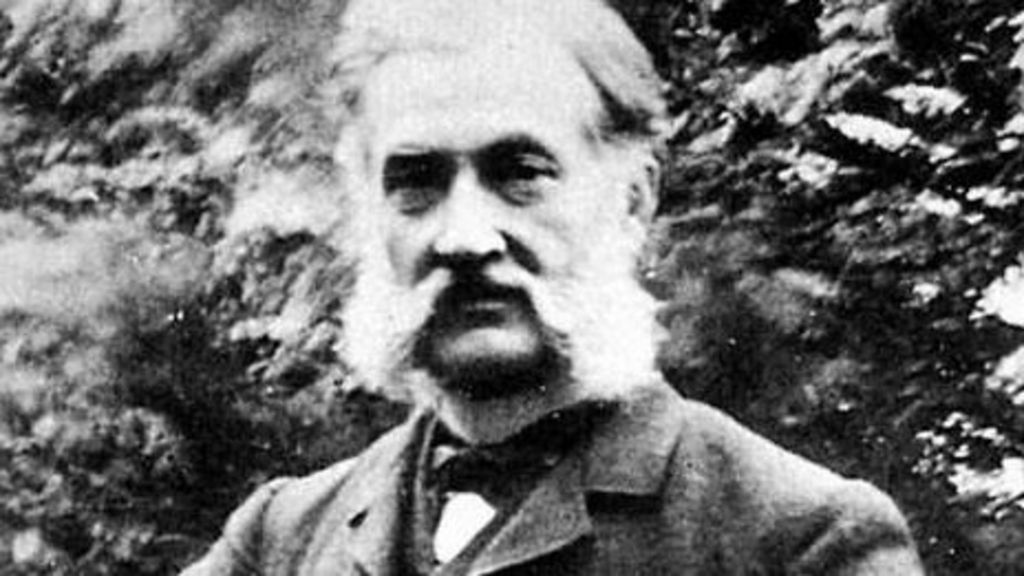
What you just saw was the first motion picture made from a single lens. The film was made by a man named Louis Le Prince. Louis Le Prince used Eastman paper film on a single lens, meaning he was using one camera unlike several like Eadweard Muybridge, to create the Roundhay Garden Scene and Traffic Crossing Leeds Bridge (http://youtu.be/wTlXaqG4VyE) in1888. Le Prince was secretive about his process and planned to display his films in New York in 1890. On September 16, 1890, Louis Le Prince with his camera boarded a train in Dijon, France headed to Paris. He would never be seen again. Some suspected he went into hiding to escape his debts. Some suspected that New Jersey gangster Thomas Edison put the hit on him. All we do know is it remains a mystery to this day. 


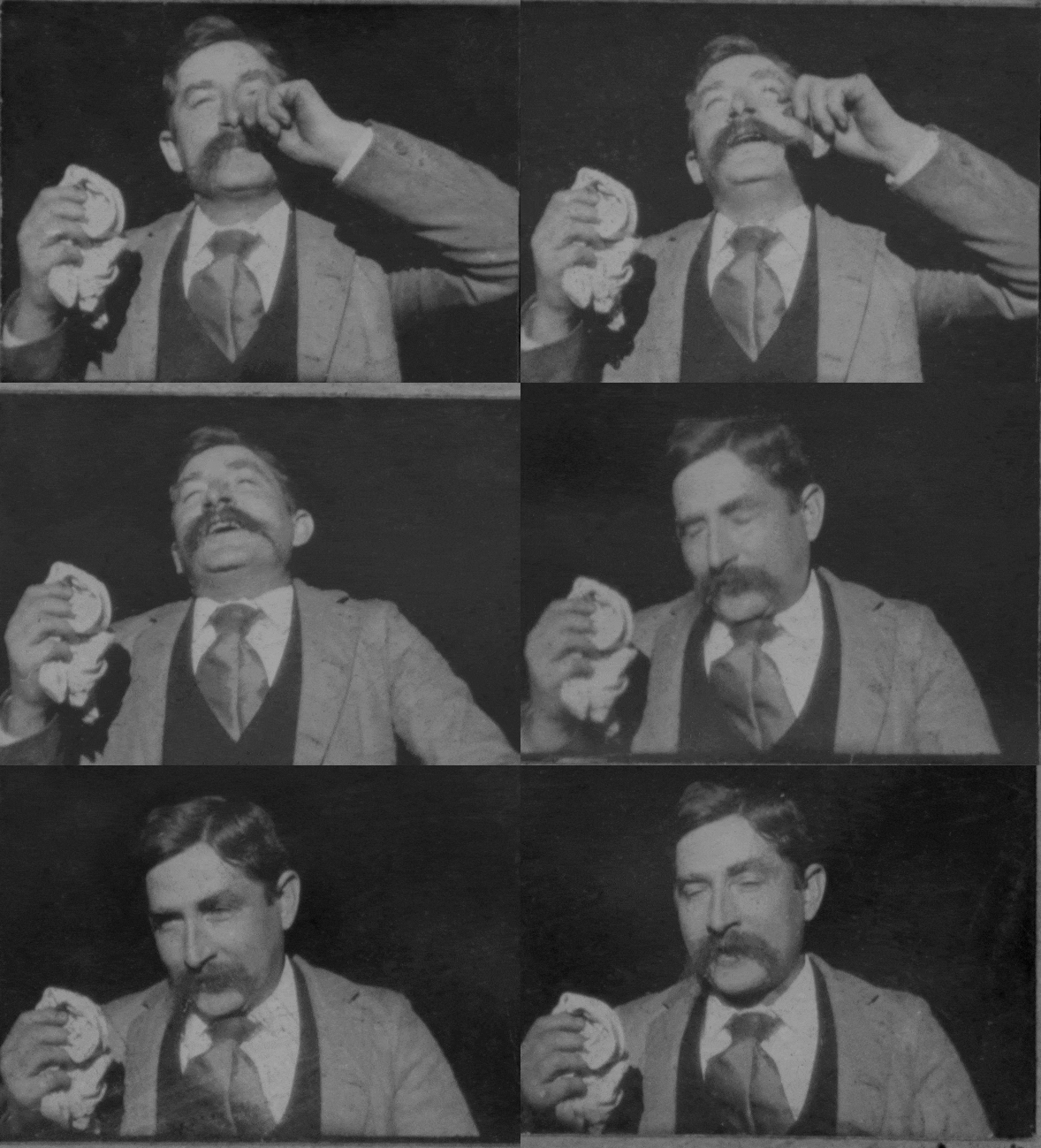
Meanwhile across the pond, Thomas Edison was working off of Muybridge's work and developed the Kinetoscope. The Kinetoscope was a device where a single view could look through a peephole and see a film in a loop. Thomas Edison would have built a production studio that was designed to follow the sun (Edison may have invented the light bulb, but his bulbs weren't up to the amount of light needed for the film exposers), it was called the Black Maria. The first film to be copyrighted in the U.S. would be Fred Ott's Sneeze  http://upload.wikimedia.org/wikipedia/commons/8/8f/Fred_Ott_Sneeze_L.gif. It would take more than a single viewer device to bring film in the a real art form, it would take projection. It would take two French brothers.


Louis and Auguste Lumière, two French brothers who owned and operated the biggest manufacturer of photographic plates in Europe, were asked to make a cheaper alternative to Edison's kinetoscope. What they would make would make motion pictures available to a mass audience and provide the framework for film to grow into the mature art form it is today. Their camera would not only be able to shoot film it would be able to project film. December 28, 1895 in the Grand Café in Paris they would have the first public screening of ten short films. (https://youtu.be/4nj0vEO4Q6s). They would tour their film around the world, but ultimately they would give up on motion pictures saying "the cinema is an invention without any future". They would  sell their camera to anyone who was interested. One of those interested parties would be someone who saw the magic cinema had to offer. He would be the cinemas first real auteur.    


At a private showing of Lumière's film December 27, 1895 (the day before the Lumière brothers legendary showing public showing) was a French magician. The Lumières could not see a future in cinema. This magician would see the magic cinema had to offer. He would buy a camera. He would make the first real classics. His name Marie-Georges-Jean Méliès, known to the world as Georges Méliès. One day while filming a cart going down the street his camera jammed. When they got it restarted it was replaced by a new cart. What Méliès had invented was the jump cut. Méliès made the first horror film (https://youtu.be/OPmKaz3Quzo). The first science fiction a film you all know (http://youtu.be/koCmmuCRlgs). (It should be noted the film was not filmed in color. It was hand painted. This color version was thought lost and was only found recently). Méliès would make over 500 films (most lost). What he wouldn't do is change the perspective. All his shots would be from one angle (like watching a play). Even the shot in A Trip to the Moon where the moon comes closer and closer the camera the camera was not moved, the moon was moved.


Across the pond, Thomas Edison was having movies made left and right, and suing anyone who copied his equipment (down to the film loops) or films (all while stealing films like Méliès A Trip To the Moon). Edison didn't do much of the directing. One of his main guys was Edwin S. Porter. In 1903 he made Life of an American Fireman (https://youtu.be/p4C0gJ7BnLc). He did something crazy, he went from a shot of the interior of the house, showing the action inside, then he showed the action outside the house. When you think of what had been shown before or any plays that you might have seen you saw the perspective from one angle and one point of view. What seems so natural to us watching a movie was ground breaking then. Distributors didn't know if the customer would be able to follow the action.


That same year Porter would make the first film with a structure that we would see as a modern film. The Great Train Robbery https://youtu.be/r0oBQIWAfe4. It would employ a continuing story line, cuts to close ups, and cuts between scenes. Edwin S. Porter and Georges Méliès would start the language of film. They would give way to the man who would give it its grammar , D. W. Griffith.   

History of Film Part 1- Gambling on Horses

Like so many things, the history of the motion picture started with a bet and a horse. In 1872, former California Governor Leland Stanford was a horse racing enthusiast and didn't feel too bad about throwing down the big bucks on a bet as to whether all the horse's feet came off the ground when the horse was at a gallop. The prevailing view of the time was that a horse always kept one foot on the ground when galloping. Leland Stanford said nay nay to that and was ready  to put his money where his mouth is. He bet $25,000 (that's in 1872 dollars, he's what Las Vegas would later refer to as a whale) that all the horse's feet do come off the ground. To prove his case he hired world famous photograph Eadweard Muybridge.                                                    


Muybridge would use a method that those wascally Wachowski's movie, The Matrix, would win an Oscar for over 120 years later (roughly, to the method and the date). He set up 12 cameras along a track that were set to go off as a galloping horse set off trip wires. The end result needed refinement, but led credibility to Stanford's ideas of "unsupported transit" in the gallop. In 1877 and 1878, Muybridge would refine his process and get this:
Or, when played in a zoetrope (you'll have to look that one up yourself), you get this:  http://youtu.be/IEqccPhsqgA


Needless to say, Leland Stanford won his bet, horses can fly, briefly, through like four frames. And a new art form was conceived. It would be another 37 years before the motion picture would be given Birth (of a Nation) to. But, for now' Eadweard Muybridge had a seed, a seed he would build on a touch with works like this http://youtu.be/5bqu6YsQocU, but it would take those no good-nicks from across the sea, the French, to really move the technical and artistic qualities forward. But first, a short tale of a New Jersey gangster, Tony... I mean Thomas Edison. 

About the same time Eadweard Muybridge was taking pictures of horses, Thomas Edison was inventing the light bulb. The light bulb would be crucial in projection, but we're not there yet. Thomas Edison would meet with Eadweard Muybridge and Edison's involvement with the birth of cinema would not end with his inventing the light bulb or meeting with Muybridge, but more to come on that. Next in part two, we're off to France.  

Monday, April 27, 2015

Andrei Tarkovsky

Andrei Tarkovsky


"Tarkovsky for me is the greatest (director), the one who invented a new language, true to the nature of film, as it captures life as a reflection, life as a dream."
                                                                                                                          Ingmar Bergman

Sergei Eisenstein's films where rooted in brute psychology. The Russia school of film theory and the Russian montage it produced where rooted in the idea that men where meat machines. That matter was all there is. That the laws of nature could be used to control men by implanting the ideas of the grand Communist state in their heads without them knowing it. The Russian montage, in this respect, failed. But, after Eisenstein would come a much different Soviet director, Andrei Tarkovsky.

Tarkovsky's films had nature, but the also transcended that. They had the physical and the metaphysical. In a word, Tarkovsky had God in his films. For a Soviet director at his time this was scandalous at best, dangerous at worst. Ultimately this would lead to him defecting from the Soviet Union and making his last two films in Italy and Sweden. I want to look at Tarkovsky's interaction with the physical and metaphysical in three of his films; Andrei Rublev, Solaris and The Stalker.

Andrei Rublev


Andrei Rublev begins with this scene http://dai.ly/xkenhz. Tarkovsky's camera, along with his monk, transcend the world below. They rise above, but at the end of the scene the "metaphysical" and "physical" come crashing together. If your only taking this scene from a physicalist perspective this scene seems disconnected from the rest of the film (other than it being a Middle Ages monk). But if you take this scene in a theistic, even Christian, way you can ground the scene in the art of Andrei Rublev, the crude jokes of the jester, the making of the bell, and God creating man in his image. Transcendent.

But, Andrei Rublev, and all Tarkovsky's, work is rooted in not only transcendent, but in the physical. The man in the balloon comes crashing down. The caricatures aren't above it all, separate from the environment. Their down in the earth and the mud, the mocked, they laugh, they suffer injustice. Take this scene http://youtu.be/FAuVQ1gVdEU.

Andrei Rublev is in many ways a brutal film. It's caricatures suffer. It's protagonist suffers. And after over 3 hours of stark black and white the film ends like this http://youtu.be/FsEbrhv2jGY. We see Andrei Rublev's art, not in black and white but in all the glory of color. And not new. Centuries old. And Tarkovsky ends on the face of Christ and horses in the rain. The metaphysical and the physical. Transcendent.

Solaris
 

Tarkovsky's next film would go from Middle-ages Russia to Russia in the future.  But it would start like this http://youtu.be/ZfUjBUX0wrM. The film then spend the next thirty minutes in the country at the main characters childhood country home. Contrast this with Steven Soderbergh's remake, who's main caricature lives in an apparent in the city before arriving at the space station circling the plane Solaris in an elaborate docking sequence. Tarkovsky takes us from the lush country to here http://youtu.be/rswYl7RLRNE. The scene is drawn out. It lasts for the nearly five minutes. Tarkovsky is talking us from God's nature, to man's city, to man's space station around God's planet. But the film is ultimately about what it is to be human. Kris, the main caricature, finds when he gets to Solaris that the planet itself seems to be alive, and it brings those you've left behind back to life. In Kris' case it is his wife who killed herself. His "new" wife can't cope with what she is (human or not human, his wife or something else, why she killed herself) and kills herself over and over again only to be brought back the next day. Watch here how Tarkovsky brings together the physical and metaphysical in his characteristics existential problem  http://youtu.be/FcglyhUre4w. Tarkovsky ends the film like this(http://youtu.be/Jorf-2o5YfU) . Contrast this with Soderbergh's, which ends in the main caricatures apartment questioning his humanity. Tarkovsky's highlights Kris' humanity, provides forgiveness to his father and highlights nature well providing questions of the nature of what it is to be human.  

 Stalker

Stalker takes place in a future in which a chemical and/or nuclear disaster has made a large area "unlivable". This area is called The Zone. People named Stalkers will take you in The Zone so you can find out its great mysteries and more so about yourself. There's a million ways different directors might depict the city and The Zone. None would be like Tarkovsky's vision. The city was shot in washed out sepia http://youtu.be/PG0Ycueti7c. But The Zone looks like this http://youtu.be/JcevEw1vczQ. The city they live in is less than real, but The Zone is hyper real and full of invisible dangers. One could say the city could be the repressive Soviet Union and The Zone the west which the Soviet Government is trying to keep their people from. The Stalker the one who knows the ways of sneaking the Soviet citizens to the west and his companions, who upon entering the west, are lost forever.   But I think what is clear is that in The Zone there are things going on which are transcendent of the physical world. This is summed up in this film more than any of Tarkovsky's film is the final scene here http://youtu.be/dNiVFCWMrqI. A distant train rattles the cups on the table, and then the little girl, with her mind, pushes the glasses across the table on to the floor.